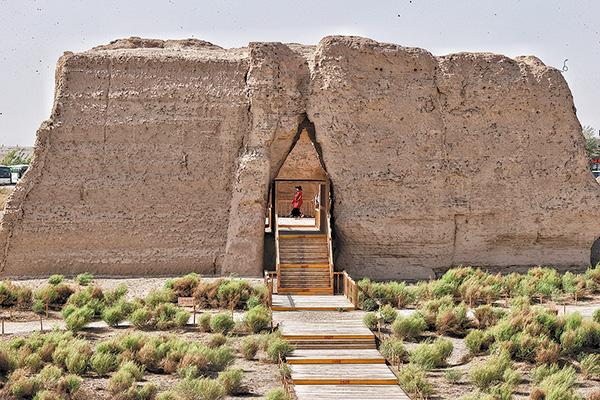
Yumen Pass
Overview
Yumen Pass, also known as Jade Gate Pass, is a historically significant site located in the Gobi Desert, approximately 90 kilometers northwest of Dunhuang in Northwest China's Gansu province. It served as a strategic point on the ancient Silk Road and played a crucial role in facilitating trade and cultural exchanges between the East and the West. The pass, named for the jade that reportedly passed through it, is part of the remnants of the Han Dynasty (206 BC-AD 220) Great Wall. Its historical importance and well-preserved ruins have earned it a place on the UNESCO World Heritage List as part of the "Silk Roads: The Routes Network of Chang'an-Tianshan Corridor."
Historical Significance
Constructed during the reign of Emperor Wudi (156-87 BC) of the Western Han Dynasty, Yumen Pass was established to counter threats from the nomadic Xiongnu tribe and later functioned as a customs office. The pass is comprised of two fortresses, 20 beacon towers, and 18 sections of the Great Wall, spanning nearly 200 kilometers through no man's land northwest of Dunhuang. It is an exemplar of the military installations of the time and has witnessed centuries of trade, diplomatic missions and cultural interactions along the Silk Road.
Archaeological Discoveries
A wide array of artifacts has been unearthed at Yumen Pass, including over 2,400 items such as bamboo and wooden slips, silk products, weapons, farming tools, pottery and lacquerware. These artifacts provide valuable insights into the daily life, governance and cultural exchanges during the Han Dynasty. The Yumen Pass Bamboo Slips of the Han Dynasty, for instance, consist of 729 bamboo and wooden slips from various beacon tower ruins in Dunhuang, providing critical data on ancient Chinese bureaucracy and Silk Road exchanges.
Preservation and Challenges
The preservation of Yumen Pass is a testament to the enduring legacy of the Han Dynasty's architectural prowess. Despite being exposed to the harsh conditions of the Gobi Desert for over two millennia, the remnants of the pass have survived due to the unique construction techniques that involved layers of fine sand, reeds, or rose willow. Modern conservation efforts, including the use of technology and dedicated staff like Zhang Jianjun and Chen Wanying, ensure the site's continued preservation in the face of natural and anthropogenic threats.
Cultural and Touristic Impact
Yumen Pass is a prominent cultural heritage site that attracts tourists and scholars alike, contributing to the broader tourism economy of Dunhuang. The site, along with other heritage sites in the region, forms part of the Silk Road's historical narrative that draws millions of visitors interested in the art, history and cultural exchanges of ancient China. The city's rich cultural tapestry, highlighted by attractions such as the Mogao Grottoes and Yangguan Pass, further emphasizes the region's significance as a cultural crossroad.
Modern Developments
Recent archaeological and scientific advancements have enhanced the understanding of Yumen Pass's historical context. Conferences and publications, such as the works presented by the Gansu Jiandu Museum, have spotlighted the significance of bamboo and wooden slips, offering new perspectives on ancient Chinese administration and Silk Road history. The site continues to be a focal point for historical research, providing vital information that enriches the academic discourse on the Han Dynasty and its interactions with neighboring regions.
As a UNESCO World Heritage Site, Yumen Pass not only preserves the legacy of the Han Dynasty's architectural and military achievements but also serves as a testament to the enduring spirit of cultural exchange and cooperation that defined the Silk Road era. Article reference1. Guardians of the Great Wall. chinaservicesinfo.com. 20232. Past resonates at ancient site on Silk Road. chinadaily.com.cn. 20213. Gansu Jiandu Museum showcases bamboo and wooden slips culture. chinaservicesinfo.com. 2019Photo Gallery(3 pictures)CategoriesCultural HeritageTagTangible Cultural HeritageRelatedGreat WallSilk Roads: the Routes Network of Chang'an-Tianshan CorridorCatalogue1. Overview2. Historical Significance3. Archaeological Discoveries4. Preservation and Challenges5. Cultural and Touristic Impact6. Modern Developments- - - []








